Yes, you can teach your bird to talk, and you can start today. The process is not complicated, but it does require consistency, patience, and realistic expectations about your specific bird. Whether you have a budgie, a cockatiel, an African grey, or an Amazon, the core method is the same: pick a word, say it repeatedly in short daily sessions, reward any attempt, and build from there. This guide walks you through every step.
How to Teach My Bird to Talk: Step-by-Step Training
Maya Harris
22 Mar 2026
First, understand what actually makes a bird talk
Not every bird will talk, and that is not a failure on your part. Vocal mimicry varies significantly across species and individuals. African grey parrots, Amazon parrots, cockatoos, and cockatiels are among the best-known talkers. Budgerigars and lovebirds can also be taught to speak over time, even though they are smaller. But within any species, some individuals are chatty and some simply are not.
Age matters, but not as a hard cutoff. African greys, for example, often begin producing continuous speech-like utterances around 12 to 18 months of age, though some may say single words or phrases even before 6 months. The good news is that parrots are open-ended vocal learners, meaning they can pick up new words throughout their lives. If you have an older bird, do not give up. Progress may be slower, but learning is still possible.
Bonding is probably the single biggest factor people overlook. Birds are far more motivated to mimic the sounds of animals they feel connected to. If your bird is not comfortable with you yet, speech training will stall. Before you push hard on talking, make sure your bird is relaxed in your presence, will step up onto your hand, and does not panic when you approach. If you just brought your bird home, give it about a week to settle in before starting structured training sessions.
Set your expectations honestly. Some birds start mimicking within a few weeks of training; others take months. A bird that babbles, clicks, or makes syllable-like sounds is already progressing through the early stages of vocal learning. That is not failure, that is the process.
Set up the right environment before you begin
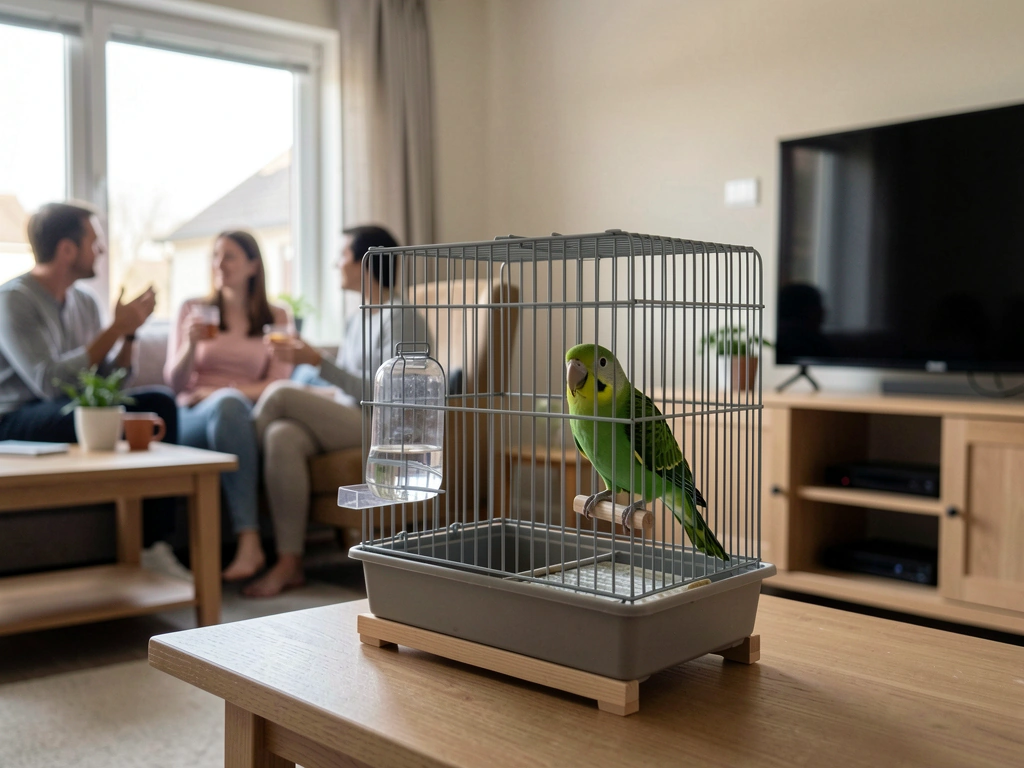
Where your bird lives day-to-day has a direct effect on how quickly it learns to talk. Place the cage in a room where people regularly have conversations. Your bird is always listening, and passive exposure to human speech throughout the day reinforces what you are actively teaching. Talking softly to your bird several times a day, even casually, counts as training time.
For formal training sessions, use the same room every time. Consistency in environment reduces distraction and helps your bird understand that this specific setting means learning time. Turn off the TV and reduce background noise during sessions. A noisy room makes it harder for your bird to isolate your voice and reproduce what it hears.
Keep the cage away from high-stress locations like drafty windows, appliance noise, or areas with heavy foot traffic from strangers. A calm, familiar setting makes your bird more receptive. Birds that are stressed, overstimulated, or anxious are not in the right mental state to learn.
Choose the right first word and teach it step-by-step
Pick one word or a short two-word phrase. Do not try to teach multiple words at once. The best first words are short, have clear consonants, and ideally mean something in context. Words like "hello," "step up," "pretty bird," or the bird's own name work well because you can say them naturally during daily interactions rather than only during drills.
Context and association speed up learning significantly. If you say "hello" every single time you enter the room, your bird starts to link the word with your arrival. Lafeber's research into object-labeling approaches supports this: when a word is attached to a consistent real-world event or object, the bird grasps its meaning more quickly and repeats it more reliably.
Here is the step-by-step method for teaching a first word:
- Choose one short word or two-word phrase and commit to it for at least two to four weeks before switching.
- Say the word clearly, at a moderate volume, directly to your bird. Make eye contact. Repeat it three to five times in a row.
- Pause and watch your bird. Any vocalization, even a click or a mumble, is a response worth noting.
- If your bird makes any sound that resembles even part of the word, immediately reward it (more on rewards below).
- End the session on a positive note, even if there was no mimicry yet. Never push past the point where your bird looks disengaged.
- Repeat the same word in every session, every day, until the bird produces a recognizable version of it.
- If after several weeks the word is not clicking, try a different word. Some sounds are easier for individual birds than others.
How to use repetition and positive reinforcement the right way
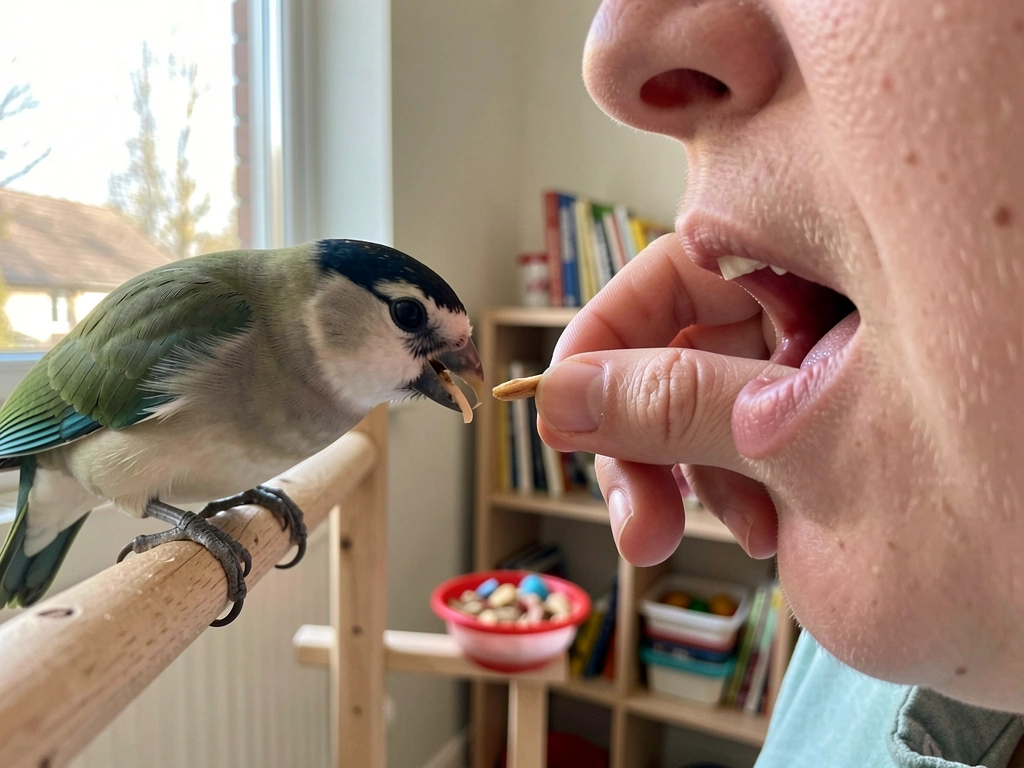
Repetition is the engine of this process, but reinforcement is what makes repetition work. Without a clear reward tied to the right moment, your bird has no idea what it is being asked to do. The key principle is this: the moment your bird makes an attempt that moves toward the target sound, mark it and reward it immediately.
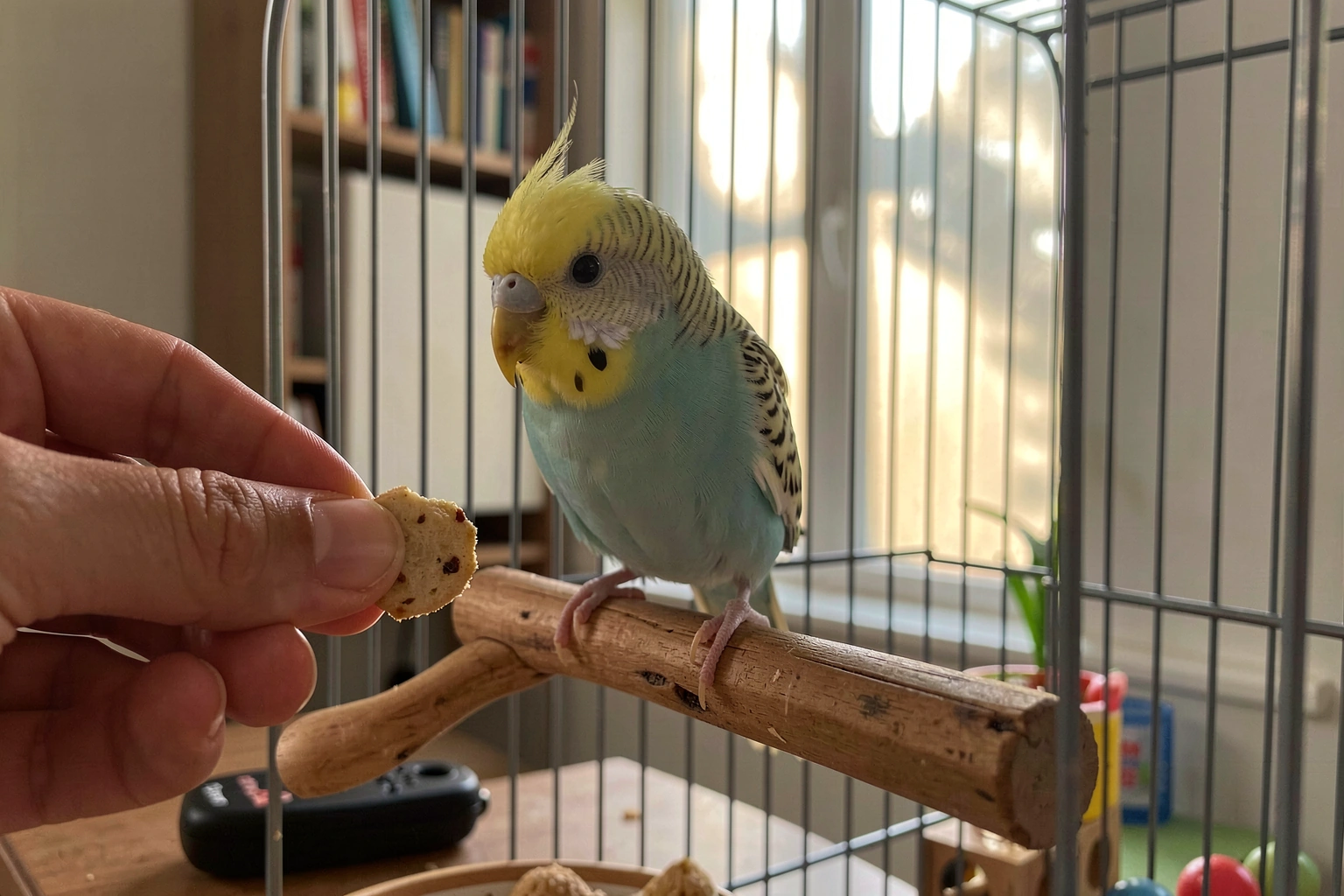
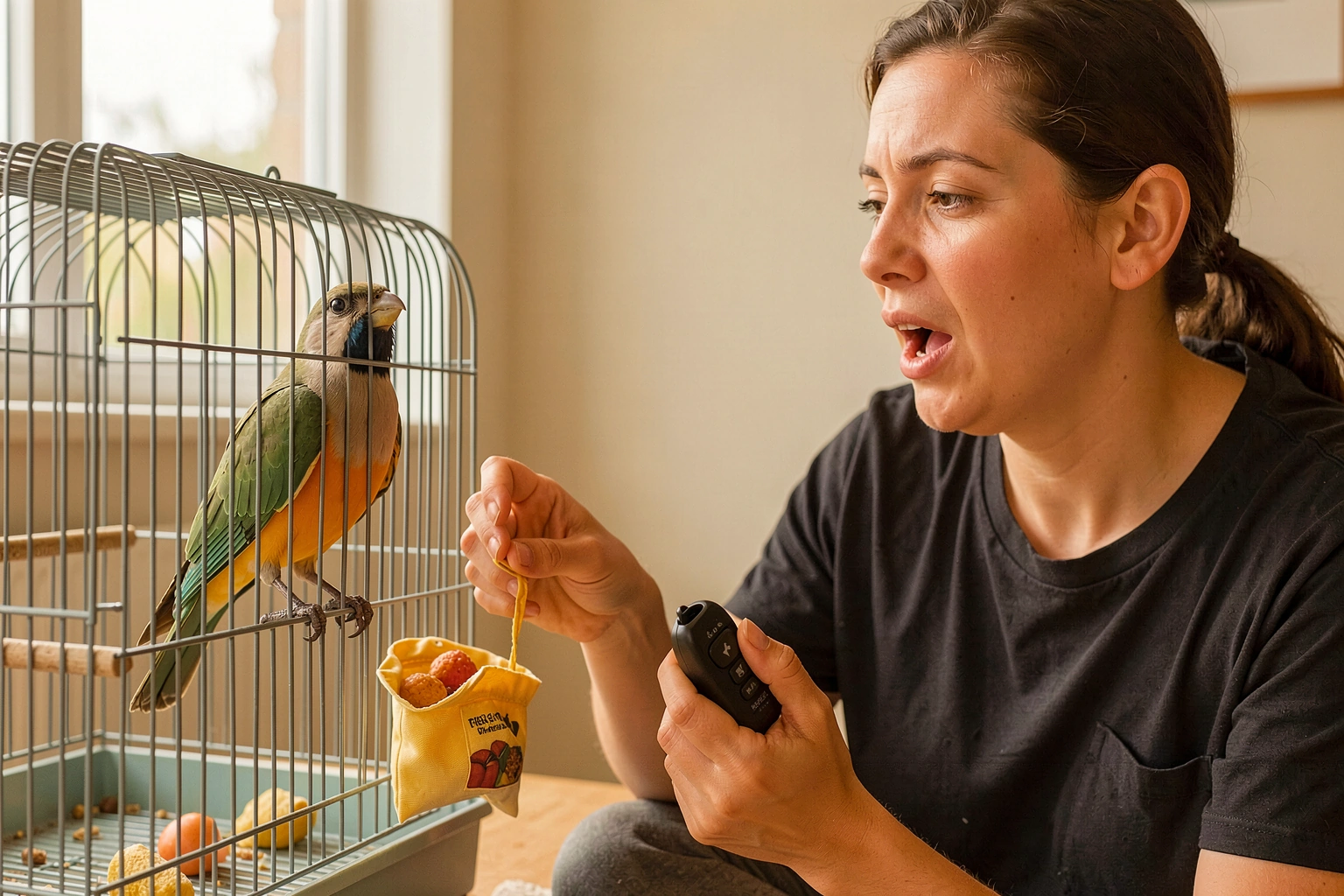
You can use a clicker as your marker, or you can use a short verbal cue like "yes" or "good." If you use a clicker, spend a session or two first teaching your bird that the click sound means a reward is coming. Click, then immediately give a treat. Repeat this until your bird perks up at the sound of the click. Once that association is solid, the clicker becomes a precise communication tool.
For food rewards, use small, high-value treats your bird genuinely likes. Almond slivers, carrot pieces, Nutri-Berries, and sunflower seeds all work well. Keep portions tiny so your bird stays motivated across the whole session rather than filling up after the first treat.
A common mistake is only rewarding a perfect reproduction of the word. Early on, reward approximations. If you are teaching "hello" and your bird says something that vaguely sounds like "ha," reward that. As training progresses, raise the bar gradually, requiring closer and closer approximations to the full word before the treat appears. This shaping technique is how birds learn complex vocalizations step by step.
How to structure your training sessions
Session length matters more than most people realize. Start with one or two sessions of 5 to 10 minutes per day. As your bird builds focus and engagement, you can extend to two sessions of 10 to 15 minutes each. Do not go longer than 15 minutes per session. Most parrots lose interest or become frustrated after that point, and training past that threshold is counterproductive.
Schedule sessions at the same time each day. Morning and late afternoon tend to work well because birds are naturally more active and vocal at those times. Consistent timing helps your bird anticipate training and arrive at the session in the right mental state.
Watch for signs that your bird is done: turning away, fluffing up, moving to the far side of the perch, or becoming agitated. When you see those signals, stop the session. Always end before your bird checks out completely, ideally on a positive moment. Over time, you will learn exactly how long your individual bird can stay engaged.
As weeks pass and your bird starts producing the first word reliably, you can introduce a second word using the same process. Do not abandon the first word once it is learned. Keep reinforcing it occasionally so it stays strong. Think of it like building a vocabulary list: you keep reviewing what you know while adding new items.
When your bird won't talk or won't copy you
This is the most common frustration in bird speech training, and it usually has a fixable cause. Before assuming your bird cannot talk, work through this checklist:
- Is your bird bonded to you yet? If it still avoids your hand or seems nervous around you, focus on trust-building before pushing speech training.
- Are you being consistent? Missing multiple days of training resets a lot of the progress. Every day matters, especially in the first two months.
- Is the environment too noisy? Background TV, loud music, or other pets can make it impossible for your bird to isolate and imitate your voice.
- Are you rewarding at the right moment? If there is a delay between the attempt and the treat, your bird cannot connect the two. Timing must be nearly instant.
- Is the word too hard? Some words have sounds that are easier for certain species. Try a different word with clearer, simpler syllables.
- Are your sessions too long? A bored or fatigued bird will not practice. Cut the session shorter and see if engagement improves.
- Is the bird talking when you are not around? Some birds vocalize most when alone. Listen outside the room sometimes.
If your bird only talks at certain times, such as first thing in the morning or when you are in another room, that is actually useful information. Try scheduling training sessions closer to those naturally vocal windows. Many birds are most vocal in the morning and around dusk, so those may be your best training slots.
If your bird mimics sounds but they come out garbled or unintelligible, keep going. That babbling stage is the bird working through the mechanics of reproducing your voice. It is early-stage learning, not failure. Continue rewarding attempts and the clarity will improve over time.
Mistakes that stall progress (and how to avoid them)
| Mistake | Why It Hurts Progress | What to Do Instead |
|---|---|---|
| Teaching multiple words at once | Splits attention and slows learning of each individual word | Stick to one word or phrase until it is reliably produced |
| Inconsistent cues | Bird cannot form a clear association between your cue and the reward | Use the same word, same tone, same context every session |
| Only rewarding perfect speech | Bird gets no feedback during the learning curve and stops trying | Reward approximations early, then gradually raise the standard |
| Sessions that are too long | Bird disengages or becomes frustrated, making training feel aversive | Stop at 10 to 15 minutes maximum, or earlier if the bird loses interest |
| Noisy, distracting environment | Bird cannot isolate your voice to imitate it | Train in a quiet room with background noise minimized |
| Expecting fast results | Leads to frustration and giving up before progress happens | Commit to a consistent two to four week minimum before evaluating results |
| Training a stressed or unbonded bird | Stress suppresses learning and vocal experimentation | Prioritize bonding and comfort before intensive speech training |
| Delayed or inconsistent rewards | Bird cannot link its vocalization to the positive outcome | Mark and reward within one to two seconds of the target behavior |
A realistic talking timeline and your next steps
Here is what realistic progress looks like for most birds with consistent daily training. This is not a guarantee, because individual variation is real, but it gives you a framework to measure against.
| Timeframe | What You Might See |
|---|---|
| Week 1 to 2 | Bird listens closely, may increase general vocalizations, shows curiosity during sessions |
| Week 3 to 6 | Bird begins babbling or producing syllable-like sounds; some birds may produce a rough version of the first word |
| Month 2 to 3 | Clearer approximations of the target word; some birds produce it reliably in context |
| Month 3 to 6 | First word is solid; second word training can begin; some birds start using words spontaneously |
| 6+ months | Vocabulary grows; bird may begin combining words or using them in appropriate contexts |
If you have a budgerigar, expect the timeline to feel slower at first but be patient. With budgies, the NCA recommends repeating the same two-word phrase consistently and only moving on once the bird has learned those two words. It is a slower, more methodical approach, but it works.
Your action plan for today is simple. Choose one word. Say it to your bird five times right now, clearly and calmly. Tomorrow, do it again during a 5 to 10 minute session. Set a phone reminder so you do not skip days. Get a small bag of almond slivers or another treat your bird loves and keep it near the cage. That is literally all you need to start.
Once your bird has speech down, you can branch into whistling and songs, which follow a similar training structure. Many of the same principles that apply to speech training apply to teaching your bird to whistle or to expand its vocal range more broadly. But for now, pick one word, stay consistent, and give your bird time to surprise you.
FAQ
What if my bird never seems to try the word during training?
If your bird does not attempt the target word at all, switch from “perfect attempts only” to “sound shaping.” For example, when teaching “hello,” reward any attempt that starts with a similar mouth movement or vowel shape, then narrow gradually over multiple sessions. Also double-check you are using the same word, same tone, and the same context each time, because inconsistency can look like “no learning” even when the bird is listening.
Can I train whenever I talk to my bird, or should I separate training from bonding?
Keep sessions different from bonding time. You can talk casually throughout the day, but for drills use the same cue, same room, and a predictable start (for example, step up first, then say the word, then reward). If your bird expects training to be “all the time,” you may get attention, but not the focused behavior you need for vocal attempts.
Should I start with one word or a two-word phrase, and which style is easier for most birds?
Use a “practice word” that you can repeat naturally when you are calm and consistent. Short phrases can work, but only if they are spoken the same way every time and you have a reliable moment to pair them with (like “step up” right when the perch is offered). If the phrase varies in length or emphasis, your bird may learn the sound pattern loosely but struggle to reproduce the exact words.
What kinds of background noise or household activity can silently slow down progress?
Avoid heavy distractions like loud TV, but also manage subtle ones, such as other pets visiting the room, sudden hands entering the cage, or people talking over you during sessions. A bird can still be “in a quiet room” and feel unsafe. Aim for low stress and steady presence, then increase auditory complexity later once the bird reliably attempts the first word.
My bird only talks when I am doing certain things. Should I train at those times or change the schedule?
If your bird only mimics at specific times, do targeted training during those windows, and during non-window hours focus on reinforcement and bonding rather than pushing drills. You can also try a consistent “trigger,” like entering the room the same way or using the same cue before training, so the bird learns when to expect the interaction.
If my bird says the word randomly, does that count as success, and should I reward it immediately?
Yes, but don’t rely on “spontaneous talk” as the reward system. When your bird says the target word unprompted, treat it immediately if you were actively training that word. If you are not in a session, you can still reward, but keep track of whether the bird is learning the word because of the environment or because of your planned training cues.
How do I know when to raise the bar, especially if my bird is only giving a close-but-wrong sound?
If you use approximations, you should stop rewarding once you notice the bird is getting “stuck” on the wrong pattern. Example: if you reward “ha” for too long, the bird might keep giving only that. Raise criteria gradually, but on a schedule, like tightening one feature every few successful days, so the bird stays motivated without confusing what earns the treat.
What are the earliest signs that my bird is done with training?
Stop or shorten sessions when your bird shows early disengagement, such as turning away, dropping posture, lunging, or repeatedly repositioning to the far side. Don’t just wait for “panic.” Ending on a calmer moment helps your bird associate training with safety, not frustration.
My bird is friendly, but not vocal. What changes usually help when bonding is already good?
If your bird is bonding well but still not vocalizing, try increasing “opportunity to attempt.” Use shorter sessions more frequently, keep rewards very small so you can deliver multiple times in one session, and give a small pause after you say the target word so the bird has time to process and try. Also confirm you can consistently get step-up or comfortable proximity, because a bird that cannot engage will listen but may not attempt sounds.
How often should I keep reinforcing the first word after I teach a second one?
Keep a “word maintenance” plan. Reinforce the first word at least a few times per week using the same cue and context, even after you add a second word. Otherwise, the first word may fade as attention shifts to the new target.
Next Article
How to Make Your Bird Sing: Steps, Causes, and Fixes
Practical steps to make your bird sing, optimize routine, enrichment, training, and troubleshoot health and stress issue